By Laura Ollerenshaw
It is one of those idyllic summer days Alberta is known for—bright blue sky and cartoon-like clouds. Perfect for the cloud shape game I played as a kid. Perfect for a kayak trip. We are parked on the side of the highway, safe and out of the way of vehicles, but still, my body shifts from the draft created by passing cars. Anything faster than the clouds feels too fast.
“Where’s the trail?” my husband Mark asks.
“I don’t know.”
“But you’ve read the map.” Mark unhooks and pulls a kayak from the truck bed.
Ever-prepared, of course I’ve read the map, but I’ve not memorized it. The hiking guide doesn’t tell exactly where the trail starts, only where to park, and now that we’re here, I realize there are no signs.
Our son Ryan and his friend Jackson climb out of the truck and roughhouse with each other. Our other son, Matthew, age eighteen, is home in the city, working. I haven’t yet gotten used to this new reality where both my kids aren’t always with me.
“I’m sure we’ll find it,” I say. I hope it will be easy, but I buzz with anxiety. With life jackets bundled in my arms, I hook my foot around the edge of the truck door and pull it closed.
We are starting our kayak trip at Whirlpool Point—an actual whirlpool—on the North Saskatchewan River. Our friends will meet us in a few hours at Preacher’s Point, where the river becomes Abraham Lake, a man-made reservoir.
Besides the whirlpool, my worry stems from the fact that none of us have kayaked a river. We had gotten vague directions two months ago from a fellow hiker on the Hoodoo Creek Trail. The hiker was a group leader at a local Christian camp, leading young people teetering at that awkward blurry line between adolescence and adulthood. My ignorance may be reckless, but the source of the information made me think we could do this—that group leader brought kids, too. I’d also taken swiftwater rescue training and read enough online forums to learn that this stretch of river is not too difficult—the worst is the whirlpool where we are putting in. Is it in the center of the river, or on one side? Which side? Will I get stuck in it? Can we die? I imagine the headline: “Inexperienced kayakers cost thousands in rescue.”
The fact that we brought Ryan and Jackson amps up my anxiety. Both boys are fifteen; I think they’re capable, but I remember them as curly-haired three-year-olds in Spiderman and Hulk pajamas giggling over their secret jokes. When I close my eyes, the mini superheroes are transposed on these young men. I can’t separate the two images. Ryan and Jackson are on the cusp that is as much a transition for me as it is for them. One day, I explain how the world works; the next, they’re discovering it on their own.
“I think the path is here,” Ryan yells from ahead, waving.
The narrow track becomes visible, hugging the guardrail along the edge of the highway, and disappears around a rocky outcropping.
“Boys, grab an end,” I say, motioning to the kayaks.
Donning our life jackets, we get ready to carry the kayaks in pairs, side by side, with our gear stored inside the seats. Ryan pushes his glasses up his nose before lifting the front ends of two kayaks while I lift the back. Jackson and Mark lug the other two.
Fat clouds move overhead—a rabbit, a birthday cake, a horse with six legs—blanketing the trail in shadow. Skirting the rocks, the way is now evident, and relief warms my face. As we descend, the highway disappears, but the sound of passing cars persists. The rock face looks like a sidewalk pushed up by tree roots. A scrabbly, limber pine, rooted in the bedrock, twists upward. According to the hiking guide, this particular pine is estimated to be over 2,500 years old, and time contracts and expands as I ponder our insignificance on that timeline.
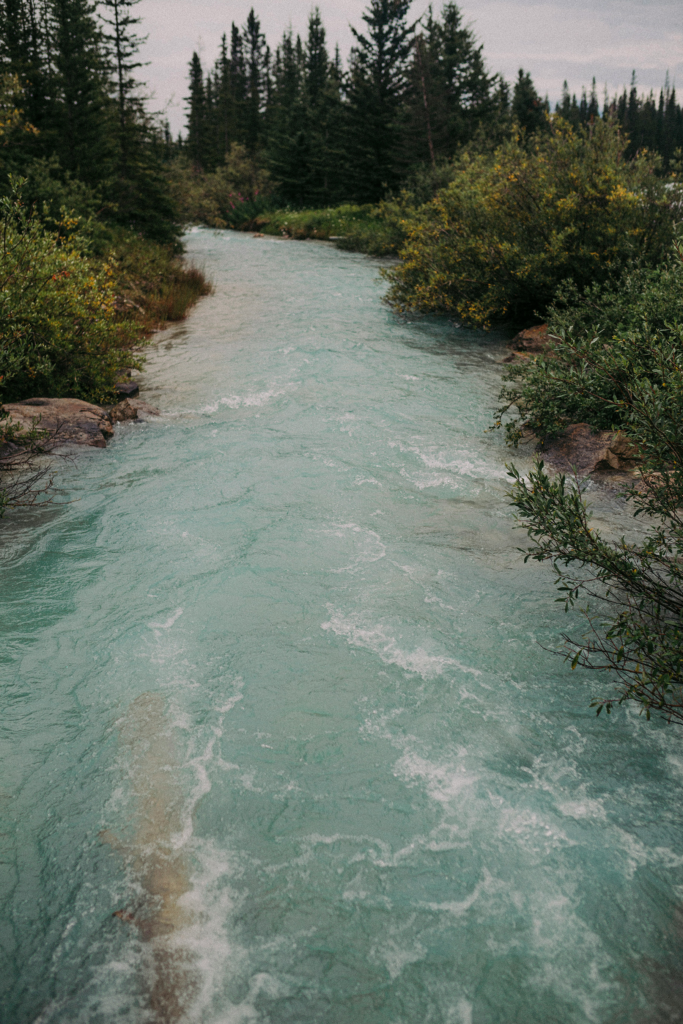
We arrive at a short beach sandwiched between the cliffs and the lapping river’s edge. The silty gray-green water reflects my uneasy emotions, dark and baleful. The whirlpool is straight across from us on the other side of the channel, noticeable because of its odd lack of forward movement. Water roils and pushes as if a presence underneath is trying to escape.
The interchangeable words “whirlpool” and “eddy,” twisting and turning through the centuries, are so tightly knotted together, it’s not clear which came first. Eddy: mid-15c, ydy, possibly related to Old Norse iðas “whirlpool,” from Proto-Germanic *ith- “a second time, again.” I search for the origins of these words because if I understand where something comes from, maybe I can see where it is going.
An eddy, often caused by barriers in the water’s path, can be a calm place for a kayaker to rest if it is on the downside face of an obstruction, like a rock. It’s moving in or out of stronger whirlpools that is most perilous. Where the water changes direction, the friction is strongest.
Here, the North Saskatchewan River bends 110 degrees, knobby, like an elbow. It’s the water washing the inside of the elbow that causes the spin.
I raise my phone to photograph the whirlpool, but in the lens, the water is disappointingly flat and extends past the edges of my screen. I know the photo will not reflect what I feel; it will not capture the calm exterior and roiling underside. I drop my arm without taking a picture. More practically, I realize that, although I cannot capture it all in the frame, the whirlpool does not extend to our side of the river. We can avoid it by paddling close to shore.
We lower the kayaks to the sandy beach while Ryan and Jackson chatter, excited.
I interrupt them with an order: “Do up your life jackets, boys. Quit messing around.”
Prepared for safety, I dole out the required gear: water bottles, throw bags, empty peanut butter jars for bailing buckets, mirrors, and paddles. All this, plus whistles hooked to life jackets. One by one, we ready our kayaks.
“Stay close to Mom,” Mark says to the boys. “She knows what she’s doing.” Do I? He flips his baseball cap around, shoves his sunglasses on his face, and pushes off. He disappears around the corner. Ryan and Jackson get into their kayaks, ready for a push. Like a mother duck, I hurry them along. I want us all together.
“Please stay close to this side until you’re out,” I warn, pushing the boys into the river. The current catches them and they slip around the corner, away from the whirlpool and me, and I realize the eddy was never a problem, only one of those hovering, intangible boogeymen that parents fear will grab children in their sleep.
As I scramble to clip my throw bag onto my life jacket, the rope inside snags on my paddle and pulls out a few feet. Struggling, I shove the rope into the bag and pull it closed. Flip-flops kicked into the boat, I push out into the water and hop in, but I sink down into the earth. Bum-scooching, I attempt to shift the kayak, but it remains stuck.
Wait for me! I want to shout, but there’s no one around, just me and the tree. I force my paddle into the silty bottom until water, instead of sand, cradles the hull and I am finally released.
Around the bend, the current pulls me and my kayak away from our launch point and the river braids, slowing its journey. Wide green water opens. Highway sounds and the whirlpool disappear, and my worry moves ahead of me.
Mark and the boys are dots on the horizon, far away.
Other than our bright red kayaks, there is no sign that we share this place with anyone. We could be the only people on the planet. I could be the only person on the planet. When hiking, the trail shows someone has been there before. Here, the groove is washed clear seconds after the paddle touches the water.
Despite the fact that Ryan and Jackson wear life jackets and know how to swim, I worry. My heart beats in my ears; panic flickers. They’re going too fast. I don’t want them to disappear. I want to be next to them. Bending my upper body and digging deep, I pull my paddle through the water, but the distance between us does not narrow. Water splashes onto my legs, and my muscles begin to ache. No matter how hard I try, I can’t seem to narrow the gap.
I stop paddling. The water is not fast. The boys appear to be in control, even having fun, splashing each other. Mark is just ahead of them.
They don’t need me.
I wish it was easier for me to know that on this day, my kids need my help and tomorrow, they won’t—but it’s never that clear. There is no defined mark on the calendar; there is no road map, and I’m learning it’s a moving target—in both directions. They may not need me today, but might next week. What scares me is that there is no going back. There are no do-overs, no second times. Maybe I have to trust that the current will show them what is important and that I’ve prepared them enough to let them go. Maybe this need to narrow the gap isn’t about them at all, but about me.
The sun clears the clouds, and my shoulders warm. The current pulls the front of my kayak sideways, the world rotating. Feeling out of control, I push forward, turning myself straight. I lay the paddle across my knees and the current pulls me around again, but I fight the urge to straighten and let the calm, slow water take me. Turned backward, I see where I’ve come from. The towering peaks of Banff National Park draw the 100-million-year-old jagged horizon line.
I had forgotten about this view. I’ve seen it so many times before, but every time it shocks me. It is beautiful, of course, but the word “beautiful” is insufficient to describe it. Taking a photo is never the same as seeing with my own eyes; the copy is always diminished, like the whirlpool that could not be captured. I try to memorize the lines, but when I close my eyes, all that’s there is the feeling it gives me—a tickle behind my eyes where the tears form.
Along the banks, sloped foothills and rocky walls are spiked with spruce and pine. The sun warms the tree oils, and I try to save that smell with the picture in my head. The water’s edge alternates between sandy and rock-strewn, and small creeks lick the edges. Like the layers of the rocks themselves, the distant lines rimming the horizon are variations of blue. Dark denim streaks the water, and each layer of mound and hill and mountain becomes a lighter shade, from navy to spruce to Aegean to stone to sky, fading into the timeline of history.
Low in the water, I feel cradled and held.
I look over my shoulder at the tiny red specks of the others, and I am thankful the river holds them, too.
Laura Ollerenshaw has an MA in creative and critical writing from the University of Gloucestershire. Her work has appeared in The Humber Literary Review, HuffPost, Mountain Life, WestWord, and Brevity’s nonfiction blog. She lives in Alberta, Canada. Website: lauraollerenshaw.ca | Instagram: @laura_ollerenshaw_writer
Photo by Colin + Meg on Unsplash