By Joy Krinsky
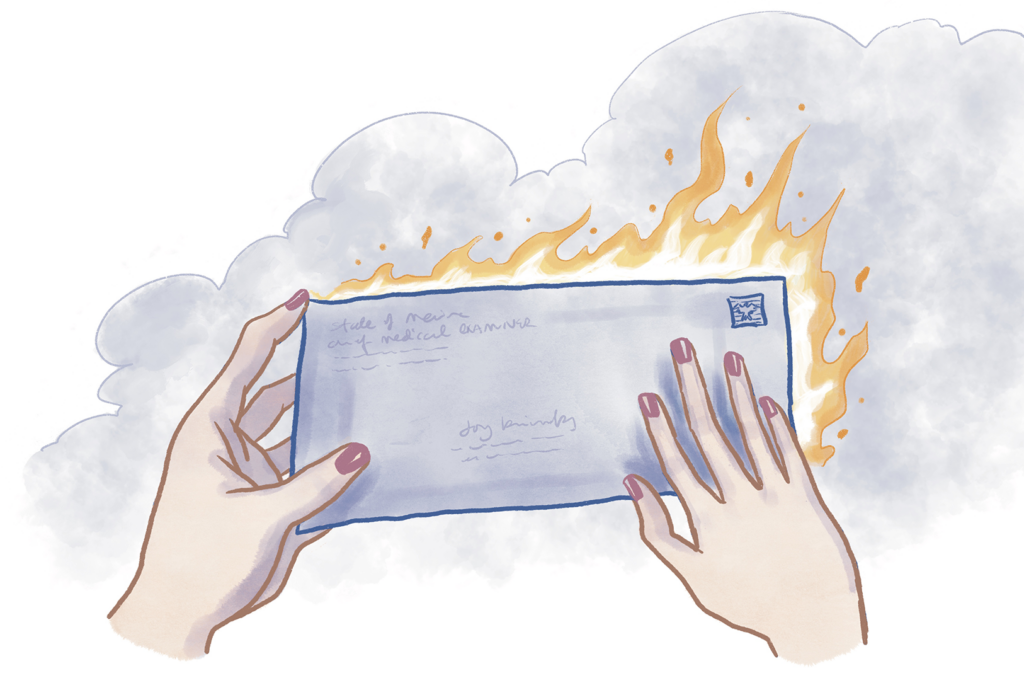
“Adonai went before them in a pillar of cloud by day to guide them along the way, and in a pillar of fire by night, to give them light.“
—Shemot (Exodus) 13:21
It had been two years since his death and two years since the suicide note was first discovered, then removed, and finally revealed to me, as a scanned attachment to an email from the police detective. I can pull up the image of that note on my phone when I want to recall precise words and phrases. Its content can be revealed and then hidden again.
But after two years, to simply see and read and access this digital facsimile of these final words, this penultimate act, was no longer enough. I needed to hold, to have in my possession, to keep close, to cleave, the original note. Weight and drag of ink across the tooth of paper. Perhaps to touch the impression of that weight, to feel the mirror of those words on the reverse side of the page. To divine a message beyond the message. To be close to the hand that no longer exists.
This growing need finally prompted action. I would request the original suicide note.
I anticipated a battle. I was ready for it. Armed with the power of my grief, and self-pity. I imagined my request being met by silence, requiring a second and maybe third request, maybe a call, or perhaps a visit.
I had encountered a variety of barriers in collecting other relics of David’s suicide. As if I was the first survivor to ever want to gather the remnants of a death, after the bones and flesh were gone in a pillar of smoke and fire.
Two years earlier, finding myself surrounded by so much evidence of an ended life, I was compelled to collect the scraps, the remains, the sacred relics of a death. The Portland Police Department report was available for a small fee. Acquiring the police photos required persistent phone calls to the city attorney before she finally agreed to release them. And obtaining the autopsy photos took multiple phone calls to the Office of the Chief Medical Examiner, an in-person appointment to sign a waiver, and an emotional, tear-filled plea. For I did not want to see the images in photos—there are some things one doesn’t look at—but I wanted to have them and keep them in my possession. Because someday. Maybe. And with something like this, you don’t want to take the chance that you missed the window, that they might be destroyed, or purged, after a certain number of years.
But on this day, there was neither fight nor delay. My emailed request, sent at 9:41 a.m. on Friday, and containing just enough information—name, date of birth, date of death, where to mail the item—was answered at 10:27 a.m. that same day.
I have placed David’s original note in our outgoing mail today, to the address you provided.
The promptness of the reply unbalanced me. Didn’t the chief medical examiner of the State of Maine know that my slow-boil emotions were not prepared for such efficiency?
And say what you will about the U.S. Postal Service, when it comes to delivering suicide notes, at least on this occasion, it did not dillydally. The envelope arrived the next day. With it came the usual torrent of self-doubt. What had I been thinking? Why had I even requested this? I’d been prepared for the righteous fight, but not the victory.
Now I had the actual object. In my own hands.
I could see the ink through the outer envelope.
That handwriting, those long strokes, slanted, letters condensed, illegible to the uninitiated.
I was surprised, and surprised at my own surprise, that David’s handwriting, that same handwriting of shopping lists, of love letters, of notes left on the table informing me where he was, was unchanged in a last missive to his family.
I had seen and read the note before—on my phone, on my computer screen. I had even printed off a copy or maybe two. The same impulse to look, to see it. But now I had the real thing, the authentic object, and I could touch it, and cling to it, and let all those sobs erupt anew—and—well, I could not.
For this object is too precious. It is now sacred. And I dare not risk damaging it with my mortal, sweaty, clumsy, sometimes bleeding fingers. I don’t dare touch it, or be touched by it. I don’t dare look directly at it.
So into the second drawer of the file cabinet, this paper in its envelope, partially obscured from view, is carefully placed and will reside. Among the police reports and CDs of photos that I dare not look at. This drawer is my own Aron Kodesh, a holiest of holy arks, made so by the sacred objects it holds.
Amongst the memories, both sweet and bitter, and the twenty-five years of a lived life together, an ephemeral pillar continues to guide me. I am led by cloud and fiery smoke. I know to not look directly at the sun, or even at an eclipse. And to not touch fire. Or ice. I know that what is sacred must be held close. And I now know that death makes you holy. And the opposite of holy.
Joy Krinsky’s writing journey began in 2019 with her spouse’s obituary and eulogy. Publications include Herstryblg.com, EpistemicLit.com, Perhaps There Is Hope: A Tisha B’Av Supplement (Academy for Jewish Religion), and The Linden Review. “In One Box” was a Best of the Net 2025 nominee. Joy lives in Portland, Maine.
Original illustration by River Rising