By Marvin Garbeh Davis Sr.
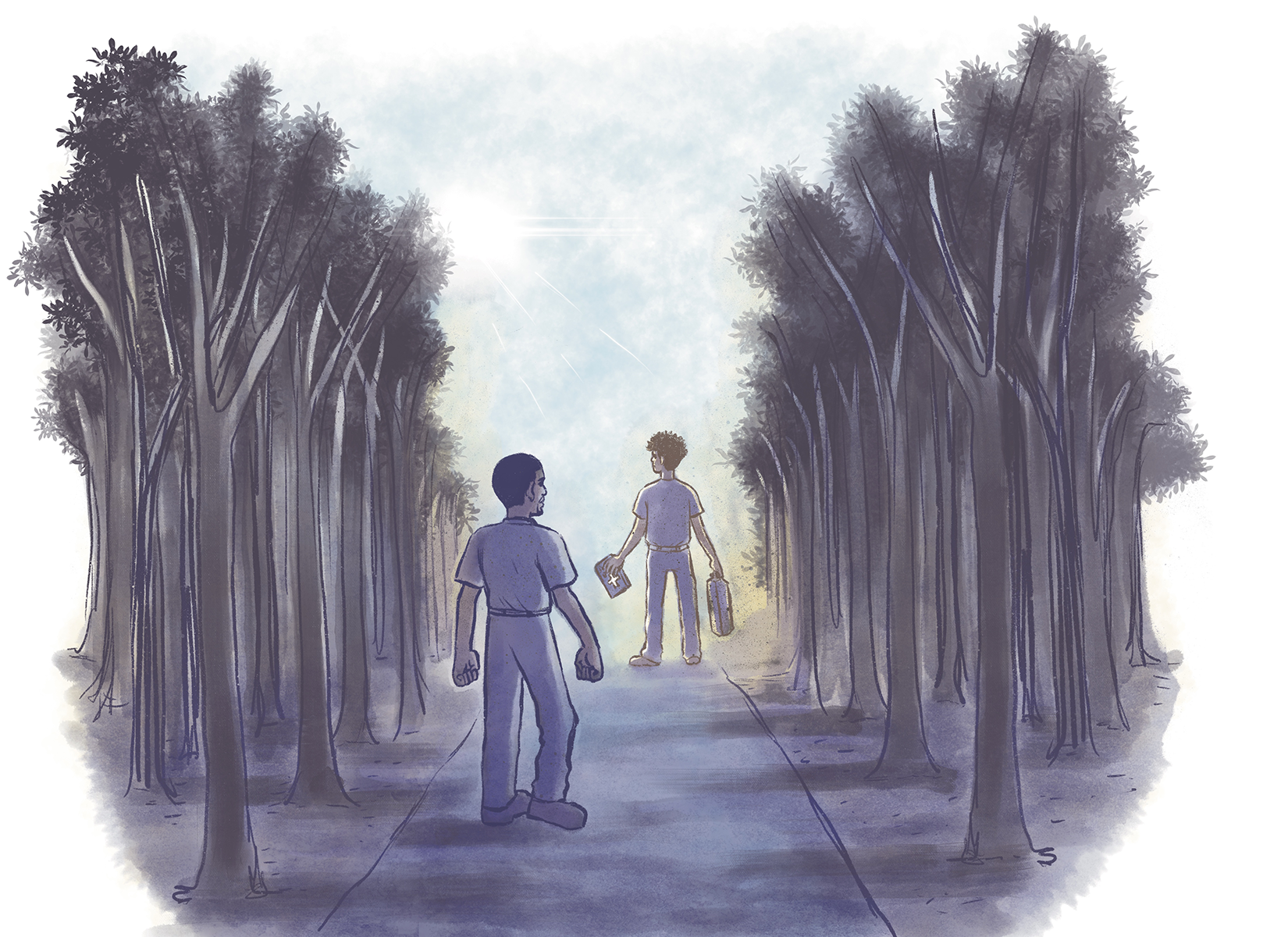
The world of my childhood was a cathedral of gray, scarred bark. In the Uniroyal rubber plantations of the Bassa lands of Liberia, the horizon doesn’t exist; there are only the vertical lines of Hevea trees, spaced with a mathematical cruelty that makes the grove feel infinite. For my father, these trees were both a sanctuary and a cage. For me, on a humid January morning in the early 2000s, they were the final threshold. This grove, both limitless and confining, defined our lives: a testament to endurance and the struggle between bondage and hope. It was a setting that promised a tale of sacrifice, its faint lines hinting at a brighter future.
To understand the weight of that morning, one must understand the weight my father carried before he ever held a tapping knife. He was a farmer by nature, a man of the soil in a village where the rhythm of life was dictated by the seasons, not a factory whistle. But that rhythm was shattered by the Liberia Frontier Force. In the years when the “hut tax” still shadowed village life, it hung over every thatch roof. If a man could not produce the coins demanded by the state, the police did not merely take his livestock; they took his dignity.
When I was a boy, sitting beside him in the evenings after work, he told me stories of the “forced porterage”—how the officers would arrest a man for nonpayment and turn him into a beast of burden. He told these stories over the years not as warnings, but as truths. My father watched men from his village being forced to carry the heavy trunks and supplies of officers for miles through the bush. There was no trial, only the road. A man walked until he collapsed, or until the officers arrested another unfortunate soul to take his place. To be a man in that time—the early years of plantation expansion in Liberia—was to be a temporary vessel for someone else’s load. My father, while part of this collective suffering, often wondered if he could forge a different path. He would think about the road beyond the horizon, imagining a life where the burden was not predetermined by the cruelty of circumstance.
In his heart, there was a flicker of defiance and an inner dialogue that questioned whether he could escape the cycle that claimed so many. It was this singular decision to flee that set him apart, a young man in his early twenties planting the seed for a future he dared to chase.
He fled that life, moving toward the Bassa lands where Uniroyal was carving a kingdom out of the forest. There, a new chapter began. He arrived one late afternoon, the air thick with the earthy scent of uprooted trees and fresh rubber. Somewhere in the distance, the rhythmic thud of machines seemed to echo a new beginning. He arrived as a young man with a heavy bag and a sense of defiant style. In the early days, he wore his hair in a thick, proud Afro that caught the light. He wore bell-bottom pants that swayed as he walked the red dust roads, and on his wrist sat a secondhand Mortima watch he’d bought from a railroad worker. He was a man who owned his time, even if he didn’t yet own his future.
But the plantation is a hungry thing. It does not just harvest latex; it harvests the men who tap it. Tapping is a job that kills a man before he dies. It is a slow erosion of the spine and the spirit. Over the decades, the plantation swallowed the man he used to be.
The Afro was the first thing to go—a tapper never keeps his hair long, for the low-hanging branches and the sticky residue of the canopy snag at anything that dares to grow toward the sky. The bell-bottoms were replaced by work-worn rags, stiff with the salt of a thousand shifts. Only the Mortima watch remained, a gleaming, scratched relic of a man who once had somewhere else to be.
The salary of a Uniroyal tapper was mere peanuts—a handful of coins that barely acknowledged the physical toll of the labor. Yet in exchange for this, the company offered one commodity more valuable than currency: a school system. Decades earlier, Uniroyal had invited the Catholic Missionary Sisters from Italy to run their institutions, and in the heart of the rubber trees, they had built an oasis of excellence.
I attended St. Joseph’s, a junior high school that felt like a sanctuary. Inside those walls, the chaos of the plantation stopped. The teachers were well paid and dedicated; the textbooks were crisp and filled with maps of places my father would never visit. However, there was a tension at the heart of Uniroyal’s generosity. The white owners of the plantation were men of profit, not of prayer. They never mixed Christianity with the harvesting of latex. There were no churches built among the rubber trees; the owners preferred the tappers to remain tethered only to the earth and the knife, unburdened by the “distractions” of a higher calling.
On the plantation, Sunday was not a day for the Sabbath. There was no rest, no bells tolling across the groves. For the tappers, Sunday was simply another day of work, sweetened by a small company bonus for those who showed up to tap. My father never hesitated. To a man with no money, a bonus is not an option; it is a lifeline. Besides, what was the sense of staying home? In the labor camps, there was nowhere to go, nothing to see but the same gray trunks and the same red dust.
Yet, as I grew and began my catechumen classes, my Sundays began to diverge from his. This marked the beginning of a new divide. I became the first Christian in my lineage, a transition that felt like a quiet rebellion. While my father disappeared into the bush at 3 a.m. to earn his Sunday bonus, I waited at the edge of our camp for the school bus, my mind a whirlwind of uncertainty and hope. I couldn’t help but wonder if my newfound faith was a betrayal of my father’s sacrifices. Was I walking away from a life that had sustained my family, or was I stepping toward a future he had unknowingly carved for me? The questions echoed quietly, a whisper of doubt as morning began to break over the horizon.
That bus was a vessel that traveled between worlds. Every Sunday, I would press my face against the window, desperate to see the scenery of a life I could barely imagine. As the bus left the dusty camp and began the climb, the air seemed to change. We entered Sparkle Hills, the residential enclave of the elite, and it was as if we had crossed a border into another country.
In Sparkle Hills, the world was emerald green and paved. I saw white men in polo shirts playing golf on rolling courses with grass kept shorter than the hair on my father’s head. Children my age rode shiny bicycles down quiet streets, and the rhythmic thwack of lawn tennis echoed from private courts.
The bungalows were massive, sprawling structures surrounded by gardens, with SUVs parked in the driveways like sleeping beasts. From the window of the bus, I was a ghost passing through a paradise built on the latex my father harvested.
It was there, among the bungalows, that St. Joseph the Worker stood. It was the only church for miles, a place for the educated and the baptized. Inside the church, I prayed for my family. I prayed for the man who was currently miles away, his back bent over a tree, making the very money that allowed me to sit in a pew in Sparkle Hills. I felt the sharp divide every Sunday: the luxury of the hills versus the survival of the camps. I was a bridge between the tapper’s task and the believer’s prayer.
St. Joseph’s only went so far. For many, the journey ended at the ninth grade—a ceiling that many of my peers never broke through. To continue meant winning a scholarship to St. Peter’s Catholic, the most prestigious senior high school in all of Bassa Land. When my name was announced as the recipient of the scholarship, it was more than an academic achievement; it was a miracle of the spirit.
The morning of my departure for St. Peter’s, the humidity was a physical weight. My cardboard suitcase held my two sets of clothes, my notebooks, and a precious prayer book and rosary given to me by Sister Clara, our principal. My father walked beside me toward the clearing. The trees waited for him, but today he had to see his son off first, even if just at the edge of the rubber farm.
As we reached the edge of the grove, the light changed. The canopy thinned. I could see the horizon—the raw, unshielded glare of the morning sun hitting the gravel of the parking lot. This was the pressure point.
My father stopped at the very edge of the shade. He could not step past the gravel. The 3 a.m. start had already passed, and he had to return to his task. The very existence of my future at St. Peter’s depended on him turning his back on me.
“Study hard,” he said. He looked at the road—the road that led to the city of Buchanan and to a life of reading books and dreaming about a different life. He had never seen where that road ended.
I boarded the transport, Bassa Land’s red dust already on my shoes. My fingers closed around the rosary beads in my pocket. As the engine rumbled to life, I recalled a phrase I had once read in a school publication about the “platform” built by sacrifice—the invisible foundation laid by those who never get to stand upon it. I stood on his weary shoulders, stepping toward a different fate. As the bus moved forward, I felt the pull of the cathedral of gray, scarred bark, echoing my father’s silent resolve. Even in my departure, the shadows of the grove remained a part of me, a final glimpse of where his sacrifices began and my journey unfolded.
I looked back as we pulled away. My father was already a silhouette, the Mortima watch on his wrist catching a final flash of silver before he turned back into the vertical gray lines.
He was disappearing back into the darkened hollows of the grove, back to the work of making trees bleed so that I could learn to pray. He went back into the shadows so that I could stay in the light.
Marvin Garbeh Davis Sr. is a Liberian writer and poet whose fiction, nonfiction, and poetry examine the intersection of memory, labor, faith, and the human condition. His work draws richly from rubber plantation histories, river communities, and Liberia’s shifting landscapes, bearing witness to the enduring spirit and the political absurdities of post-war Liberia.
Original illustration by River Rising