By Lisanne Rogers
Soft, eager chirps greet me as I enter the post office. With a sigh of relief, the clerk hands me an insulated box containing seven chicks from mypetchicken.com. I open the box and notice that one of them does not run and peep like the others. I watch it teeter around the box like a drunken Weeble—a once-popular children’s toy that wobbled but would not fall down. The next morning, I feel a pang of defeat as I lift a cold, feather-light body from the wood shavings.
The remaining chicks huddle together in the heated tub. Now and then, one drops onto its stomach with its little neck and legs stretched out to nap. They take turns preening in front of a hand mirror in the tub. Our family laughs at our vain little chicks.
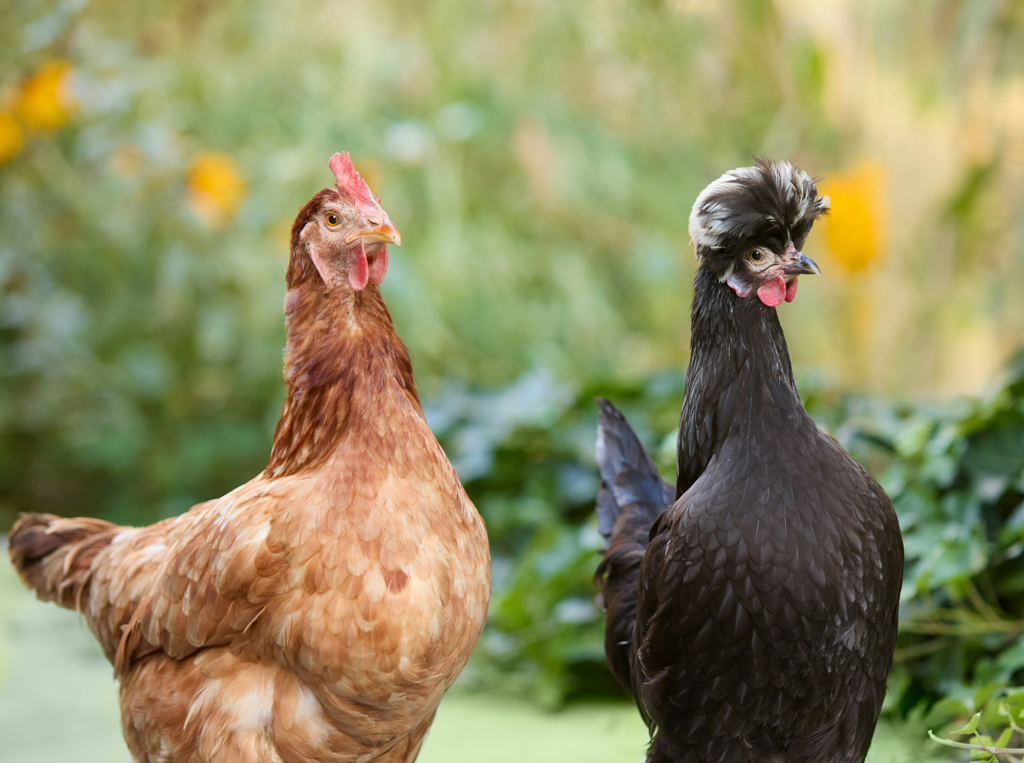
My family of accidental poultry enthusiasts has been raising chickens for nine years now. Our first batch, purchased after my twelve-year-old daughter begged for a pet chicken, arrived in 2016 and included a black Polish chick she named Gyblet. Gyblet looked like a tiny punk rocker with feathers that stood erect on her head. As she grew, her top feathers evolved into a regal crest.
Keeping chickens is generally fulfilling, but it’s not without its drama. One time, a second-batch hen bullied another hen so badly that we had to intervene. After a quick trip to the coop with an ax, my husband Jim returned the flock to civility. Our children will never forget what they refer to as “the guillotine incident.”
At nine years old, Gyblet is the only one left from our first batch of chicks. I observe the younger chickens following her around the yard, scavenging for bugs and flopping in the garden dirt. But her age is showing, and she hasn’t produced a small white egg in over a year. These days, I feel tremendous kinship with Gyblet, both of our bodies and routines changing with age. Approaching my mid-fifties, I notice that red wine gives me a headache, my stomach distends like a hot air balloon after eating pizza, and I slide open the kitchen door nightly, feverishly pulling off layers of clothing. In bed, I toss and turn in a sweat-soaked cocoon, despite the sixty-degree room. My doctor tells me I’ve entered menopause.
When Jim notices Gyblet’s decline in egg laying, he asks, “Should I take the ax out back?”
I stare at him in alarm, unsure whether he says this in jest.
“Of course not,” I say, or maybe I shout it at him.
I find myself consulting several chicken books. I read that older, more experienced chickens, called “mentor hens,” play an important role in guiding the younger members of the flock. They provide protection, establish a pecking order, and direct foraging and flock behavior. A mentor hen demonstrates dust bathing and points out rest spots.
I proudly describe Gyblet’s new role to Jim.
“How long will she live?” he asks, trying to suppress a smile.
“The chicken book says an eight-to-nine-year lifespan, but I think she’ll last longer,” I say. I suspect that even my ax-ready husband knows this is not just about the aging chicken.
I buy Lion’s Mane elixir and magnesium to ease my brain fog and improve my sleep. I investigate hormone replacement therapy. As the last child leaves the house, I search for new ways to be useful. I read books and listen to podcasts about longevity. One menopause expert advises me to “be strong, not skinny.” I stop my beloved long runs (too hard on my knees) and start strength training. Despite all the lifestyle changes, I feel new, pillowy flesh above my too-small jeans. I wonder how all my clothes have shrunk. Strong, not skinny, I repeat as I drop items into the donation bag.
My superpower sleep gene vanishes. Gone are the days of sleeping soundly for eight hours straight. I wake up at three every morning—wide awake—contemplating the world’s issues. When my alarm goes off in the morning, I am groggy and miserable. I forget names of people I know, places I’ve been.
One day, Gyblet does not return to the coop. We search and search for her. I visit all the areas of the yard that an aging hen would choose, but she is nowhere to be seen. Did a bobcat snatch her? I don’t want her to go this way. Our son ventures farther, into the scratchy sage, and finds her pressed to the ground, frightened and confused, so he carries her back to the coop.
I undergo knee surgery and suffer the indignity of wearing two knee compression sleeves on the tennis court. The tennis pro tells our group, “We’re not spring chickens anymore!”
Later, I watch Gyblet totter around the chicken run in the dying light. She holds her head high— forever feather-crested, a punk rock queen. Gyblet’s not a spring chicken anymore, either. She’s become something—someone—even better.
Lisanne Rogers has an English literature degree from the University of Western Ontario and an LLM from Fordham University. Her essays have been published in Motherwell, The Good Men Project, USA Triathlon, and White Wall Review. A mountain enthusiast, she lives in Old Snowmass, Colorado. Website: lisannerogers.com | Instagram: @lrogers426
Photo by Erwin Bosman on Unsplash