By Trelaine Ito
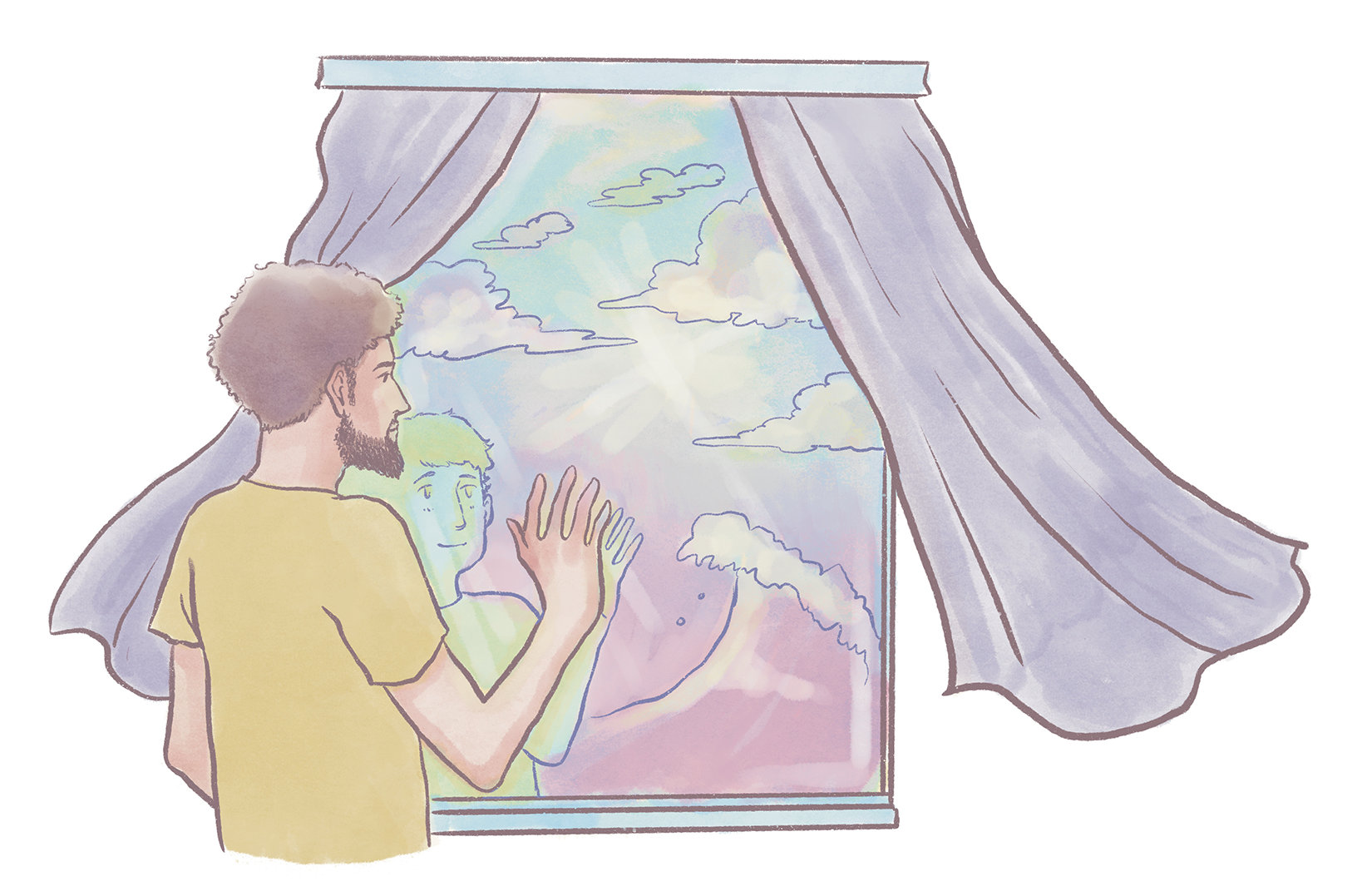
My first memory of the ocean is impossible as a pure memory. It’s an image of a child pressed against his bedroom window, staring at the edge of the visible world as it fades into dusk. The darkening water mirrors the sky’s blend of indigo and violet, mingling at the line where the earth’s curve begins. Both the child and I sense the ocean’s gaze as it watches us amid the twinkling streetlights dotting the slopes of an ancient volcano come to life.
From our vantage, the south-facing bedroom window of a townhouse on a hill in the middle of a suburb atop a plateau between two mountain ranges, Diamond Head to the east and the southern tip of the Waianae Mountains to the west, the ocean seems to spill out of Pearl Harbor, as if its waters originated from the island and not the other way around, an endless flow of streams returning to their source.
Perched on the upper level of a bunk bed, the child and I are like gods atop Olympus, observing an untamed mortal realm through our bedroom window: the cement stairs down to a shared parking lot, our mother’s red Honda in its assigned stall, two rusted green dumpsters, our father’s white Toyota parked in one of the guest spots across the lot, a tree on a hill in the far right corner next to a miniature valley where a playground waits, only the tops of its wooden bars visible, underneath which are two massive swings each capable of propelling an imaginative child into space, or at least to the manicured forest of suburban trees that separates our neighborhood from the sprawling web of development across Oahu’s southlands.
As the night descends, we are alone with the ocean as it swallows the sky. If not for the stars, one might assume we’ve been submerged beneath the ocean’s depths, trapped until the world flips and our sun rises, the ocean’s water raptured into the heavens, becoming clouds, which, in their gluttony, absorb too much and grow so heavy that they expel their excess weight over mountains like the ones surrounding my hometown. Their deluge then migrates back toward the ocean’s depths, a perilous journey as the water’s many predators, grass and trees and both two- and four-legged creatures and even porous rocks, snatch innocent droplets from the pack.
In time, though, all water eventually returns to the ocean.
And yet, despite my first memory, I’ve always dreamt of the world beyond this tiny island and its surrounding water. My mother would often say, “You were always my mainland son. You were never meant to stay here. Visit, sometimes, but not stay.” Before I could even articulate a desire to leave, she had already accepted its claim over my destiny.
I can never stay away for too long, always feeling the eventual pull of home. As I satiate one desire, the other invades. To leave. To return. To leave again and return again.
Perhaps the ocean and I share first memories of each other. If so, then over the years the ocean has noted my comings and goings, a prospect I find frightening. Will the ocean notice my inevitable failure to return? Or to leave again? When I ultimately fade into night, will the remnants of my physical form erode downstream, entering the brackish water where the land’s veins meet the ocean’s organs?
Then perhaps, too, the ocean and I will share our last memories of each other. Because even if I escape this island, even if I find myself in central Nebraska, all water returns to the ocean eventually.

Last summer, I decided to grow a beard.
It’s not that I hadn’t grown a beard before. During the pandemic I had no reason to shave, so I let my beard grow for months until, on a friend’s virtual birthday celebration, I finally saw myself reflected through my friends’ reactions, people who hadn’t seen me in a while and to whom I wasn’t quite a stranger, but I wasn’t exactly recognizable either. The overgrowth of my facial hair, concentrated in a tiny rectangle of a Zoom grid and amplified by weeks of social isolation, became a visual reminder that the world had indeed changed.
This is the first time I am home with a beard (albeit one that’s kempt and periodically manicured, like a straitlaced suburban yard, approved of by the town association and its exacting standards). And because of it, I feel like a stranger. This era, defined not only by my facial hair but also by my recent unemployment and its resultant listlessness and a fear that it may be time to return home for good, has no precedent.
I grew up in Mililani, one of the first master-planned communities on Oahu. The word “Mililani” means “to praise or exalt,” and I’ve always thought of my hometown as peak suburbia, worthy of veneration. Even as I walk through my old neighborhood, its familiar sidewalks remain unchanged since I first moved away nearly two decades ago. I consider visiting my old townhouse, climbing one of the nearby trees or even the playground, high enough to look southward and see the ocean in its mid-afternoon glory. But I’m not sure my old home’s current residents would look too kindly on my nostalgia tour (local news headlines would read: “A stranger, with a beard, is stalking the community”). Our family has long since moved to a single-family house a few streets north, one with a view of the Koolau and Waianae Mountains and the encircling wreath of clouds adorning their summits, but not of the ocean, which is blocked by our neighbors’ houses.
I miss climbing the trees near my old home. I used to pretend that different trees served different purposes, like one was a castle from which I could fire arrows (in defense only, Mom, I swear!) at invading orcs (played by my younger brothers) and one was a massive spaceship where each branch controlled a different function (navigation, shields, laser cannons, kitchen—because even in space, you needed to eat). The realization that I will never return to those imagined worlds feels like a greater loss than it deserves.
Even if I climb a tree, I’m confident that I won’t be recognized by anyone. My old friends and neighbors are long gone. My teachers have mostly retired. Only one of my brothers lives at home, and my father is out of the country for work.
I am a stranger in this town.
As a stranger, I can observe this place with fresh eyes. Like how the monkeypod trees lining the streets, having reached peak maturity to the point of consuming the roads, block the sun with their outstretched branches and disrupt the asphalt with their burrowing roots. Each tree mingles with its neighbors both in the air and underground, a tactile network of suburban foliage. Meanwhile, rows of Norfolk pines continue to stand like sentries as high as the distant mountains, guarding the parks, the elementary schools, the Walmart, the offramp to the freeway from unseen invaders, their tips drooping with the burden of responsibility.
Mililani feels older, like a village of retirees and grandparents. But there are also children everywhere, walking home from school or riding their bikes to unknown destinations. When I was young, I biked as far as my courage would take me. I stood, apprehensive, before the maw of the Rainbow Tunnel under Kamehameha Highway, a distance too great to traverse alone. My youthful eyes transformed the ravine that cut through the Mauka neighborhood into a great chasm gashing the face of the world, from which the demons of my nightmares would emerge.
And yet, I remember imagining that even if the world ended, if an asteroid hit the earth and a giant tsunami consumed everything, Mililani would survive, like a modern-day Noah’s Ark, hoisted on a plateau and walled off by two mountain ranges. As the world beyond sank into the ocean’s depth, my hometown would remain, spared simply because it was special to me, as if God had granted me that favor.
But now, Mililani, once so grand on a scale unmoored from reality by a child’s imagination, feels quite small. Whenever I leave, it shrinks until my memories of it appear outsized and overgrown—barely recognizable, familiar in a distant way, one where you aren’t quite sure what the differences are until they become so apparent they’re the only things you can focus on.
I finish my walk by deciding whether to shave my beard. Imbued in this place, its red volcanic dirt and untouched sleeping grass, its restaurants both constant and new, its homes painted in a particular set of colors, its assorted trees and surrounding mountains, is the lingering vestige of a now-abandoned era, one in which a younger version of me experiences an ever-growing world. With a beard, I can revisit this younger-me as a stranger, a temporary visitor from a different era, and I can see how his world no longer exists. But without a beard, I can slip into this younger-me’s life, savoring the awe of a hometown that feels as large as the world itself.
To shave or not to shave, that is the question. To keep my beard is to separate my life, here and there, past and present. But to shave my beard is to remove a small reminder that over the years I have changed as much as this place, that aging and adulthood have transformed my understanding of the place that raised me.
It’s actually quite a simple decision.

The drive to the airport takes about twenty minutes, during which time I do nothing but stare out the window of my mother’s white Toyota Highlander, a slightly taller vehicle that gives its passengers a better view of the sky. In the summer, flights back to the mainland usually depart in the late afternoon, which is the peak time for cloud gazing on Oahu, a period when the confluence of conditions and colors paint a spectacular scene.
I’ve always loved the clouds above Mililani, how they’d loom over the houses on my street. Sometimes they’d billow and groan, their roars echoing throughout the sticky summer day and their flashes of rage both darkening and illuminating the space under their gray bodies. And at the end of every afternoon, they’d camouflage themselves to match the setting sun, deep oranges that fade into even deeper reds until the blackness of night swallows each cloud whole.
Each cloud yearns to be captured and catalogued as reminders of both a particular moment’s beauty and the inevitability of change. I would often stop in the middle of the street or the middle of a conversation to aim my phone’s camera skyward, so often that it became my most defining feature.
The boy who loves clouds.
The atmospheric canvas displays a new masterpiece every minute, as the sun, clouds, stars, and moon make their quotidian voyages, some on discernable paths, some in zigzags like improvising dancers in the distant horizon. Clouds themselves are embodiments of change, in form and function, water vapors lifted from the ocean, transfigured through the magic of evaporation into clumps of mist condensed in the sky, swelling into plumes so big that gravity forces them to unload their lifeblood atop mountains tall enough to reach their underbellies.
In fact, the two mountain ranges that guard my hometown’s east and west flanks often display twin crowns of clouds, propelled by the Pacific’s winds and settling, at least momentarily, on the island of Oahu.
The turn onto the freeway, past the greeting sign (“Mililani: 1986 All-America City”), has the best view of these crowns, fraternal in their sameness given their variations of shading and height. They are reminders that long before its glorified Americanness, this area was once part of a kingdom. As a child, I imagined Mililani was a magical realm, almost Tolkien-inspired, hidden between the remnants of two eroded shield volcanoes and bathed in the golden light of providence.
The setting sun pauses briefly on its westerly journey, lending its brilliance to the mountain’s headdress. If not for the fact that we are on the freeway and I am not driving, I would’ve stopped the car and taken a clear picture. Instead, I stew in my regret.
As a magical realm, the enchantment of my hometown, perfectly preserved in the memory of my youth, feels both like an escape from everyday life, the ravages of which nip near the edges but seldom tear through the town itself, and like a prison, as if my younger self is trapped in an immature state, unable to grasp that he is caged.
And it is to him that I return, like visiting an old friend, unable to talk about anything else except the shared memories of our heyday. But we quickly tire of the same topics, like rain in the gulch running from sea to sky to stream to sea and sky again, unable to break the cycle and experience something new.
Over time, the memory of a place changes just as much as the place itself. Because memory is a fiction carefully crafted to sanitize the past, as if a rush of reminders could challenge the prevailing narrative.
With every departure, every moment the plane’s wheels lift off the ground, it’s as if I am actively trying to forget my first home, returning my aging reminiscence back to its storage, afraid that any exposure to everyday life will threaten the timelessness of my hometown, that my younger self will escape and, upon seeing the sun, burst into flames, unable to withstand life outside the cave.
And yet, as I remember my life in this place, I can’t help but wonder who I would be if I had stayed. Would I have found my voice? Would I have found the courage to live authentically, a queerness that was budding but undeniably dormant in my fragile teen years?
But then I imagine the disappointment of my mother. Even though she knew my stay was temporary, and even though I might never return, she was always eager to let me go, if only to ensure that I could thrive somewhere else.
As the car descends toward the ocean, the surrounding scenery quickly obscures my view, until the only things connecting me to my hometown are the clouds upon which the dancing rays of the setting sun reflect back onto my face. The same rays that dance across Mililani.
Trelaine Ito is originally from Hawaii, but, true to form, he saw the line where the sky meets the sea and it called him, so he currently lives and works in Washington, D.C. Website: trelaineito.com | Instagram: @trelaine | Bluesky: @trelaineito.bsky.social
Original illustration by River Rising