By Sarah Harley
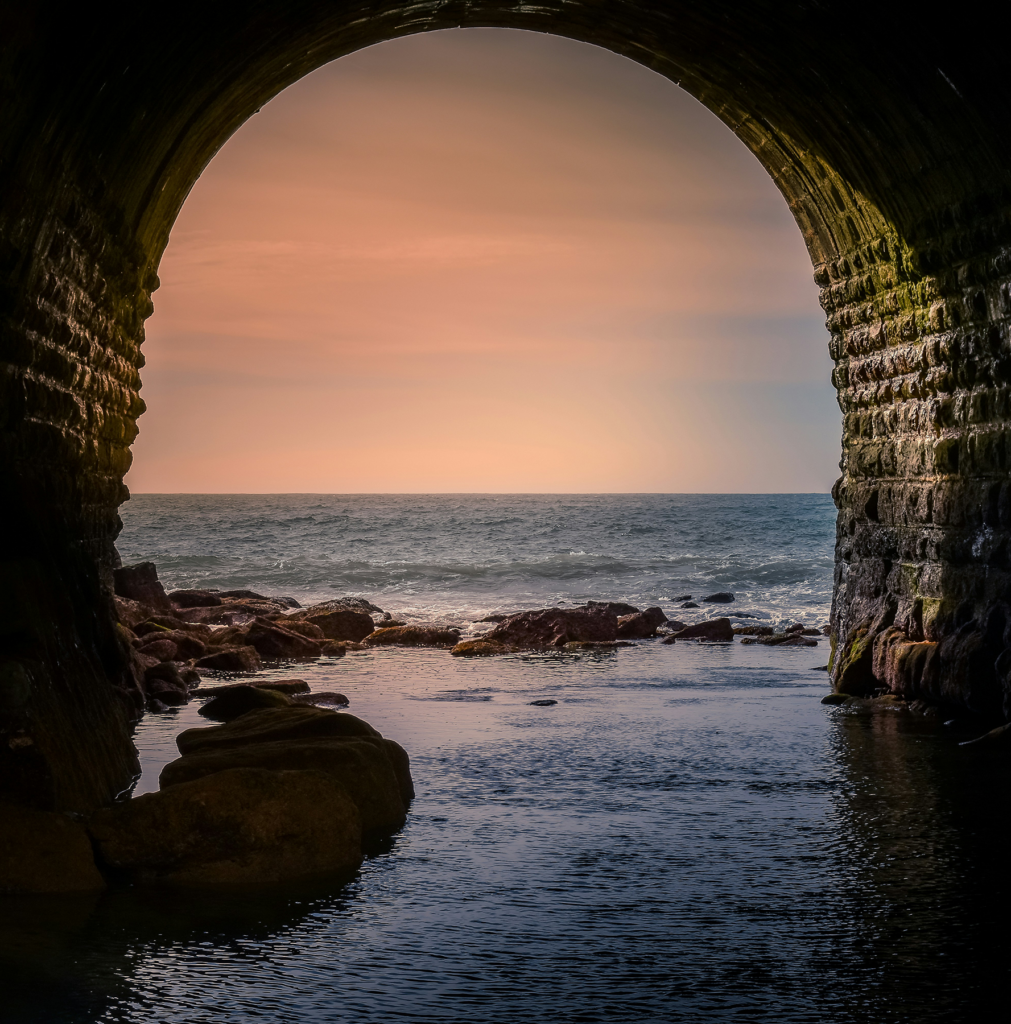
When you enter the tunnel, there’s a sudden darkness. Cool air rushes towards your face, the wind sweeps in from the sea.
The first time you go through, it’s summer. You are five. It’s the only way to reach Ness Cove, a sheltered inlet on a coastline, along the English Channel.
There’s something buried there.
You don’t realize at first, but the tunnel is carved into the side of a cliff, built by smugglers in the 1800s. At the other end, there’s a small pebble beach, fully enclosed by red sandstone cliffs. Up on the clifftops, a line of white pines extends far into the distance. Above the pale blue sea, a ghostly mist forms along the horizon. The waves break. Across the water, the distant call of a seagull echoes through the sky before trailing away.

When I’m older, I return to Ness Cove on my own. The trips are written inside my body, in the episodes I carry within me—childhood, adolescence, womanhood. In later years, I go only in my mind because I live far away. I try to piece together what has been dragged in with the tide: parts of lost nets and small polished stones; emotions and hardships, weathered by time.
The tide there rises quickly. A tidal chart is posted on a wooden sign, but the print is too small and faded to read. One must keep watch, observing the patterns in the waves, careful not to get stranded by the incoming tide or pulled into depths you can never escape. The water gradually covers the beach. The shoreline disappears, slowly at first, before it is swallowed by the sea. Strong currents and large waves reach farther and farther until rock formations and sandbars disappear. Sea caves become inaccessible as the water swells. The cove fills with the roaring noise of the sea.
At high tide, it’s too late to leave.

You again—that younger version of me—running across the sand, hurrying up the steep embankments towards the tunnel. Your hair is still a shock of white-blonde, before it turns red when you’re older. You’re wearing a navy-blue one-piece swimming suit. You hold the green handrail, slippery and metallic, afraid to slip like you did that one time—the sting of salt water in the cut, blood on the step.
At the top of the steps, there’s a weathered green door, bolted closed with a rusted chain and lock. A bright red life buoy fastened to a railing, in case of rescue. There are never lifeguards on the beach. At the entrance, a sign warns of falling rocks—the chance of a landslide. Inside, the first flickering light bulb, in an iron fixture, coated in a charcoal and bluish-green patina. Walking fast, it takes about three minutes to get to the end, where a rusted metal gate opens with a creaking groan.

The beach stretches wide and expansive at low tide—rock pools on the beach, hermit crabs and starfish, sparkling pebbles and softened sea glass along the water’s edge. The waves break into smaller ones; white foam fizzles into still water. As the tide goes out, fallen rocks become steppingstones across the water, remaining for millions of years until they are eventually worn away by the waves.
The once snap and pop of the seaweed is silenced, washed ashore near the tall green rocks that sparkle in the sunlight. The Neolithic era exists within the rocks. You balance in bare feet, sensing a portal to another time, a way to slip from the present moment.
With the outgoing tide, everything is drawn back into the sea. Standing in the water, the earliest pull of the sea to drag you away. You are seven.
The clouds on the horizon grow heavy; there’s a chance of rain. It’s time to leave.
Back through. Sand on feet. You run, feet pitter-patter, one beat ahead of your child’s heart. The walls glisten in the wavering light, shiny with dripping condensation. The air is thick with the sharp and salty smell of the sea. The stone floor sludgy under feet.
A knot twists in your stomach. Your heart races so fast you can’t breathe. Tears blur your vision until everything dissolves into a haze. Your body, like the tunnel, holds echoes, sharp edges, and flickering lights.

Always beneath layers of memory, the huddled figure of a man. I don’t know when he first appeared, perhaps I was six or seven. He haunts me in both waking and lucid dreams. He’s like a shepherd, only the bad kind. He follows me when I’m asleep. When I run up the stairs, he reaches out, just above the ankle bone, trying to grasp hold.
He goes for the parts of me that made me need to learn the names of my own anatomy. Hip bone, pelvis, abdomen. I learn that even private parts have names.
He still appears. Each time something inside tightens. My ribs lock into a cage.
To escape, I detach from the present moment, disconnecting from my surroundings. I find myself outside my body, drifting through time, suspended between here and there, never fully arriving.
Time repeats itself like a circle.
In my mind, I keep running, trying to escape, trying to remember.
At the entrance of the tunnel are public lavatories. The men’s door on the left, the women’s on the right. You run towards the women’s door in bare feet, sand still dusting the tops of your feet and in between your toes. Your child self is reflected in the mirror—the invisible girl, wet hair hanging around small, freckled shoulders. Green eyes stare back, shiny like glass but vacant as if you’re asleep—part girl, part changeling. You are eleven.
Through the years, you blink and see your reflection—part child, part woman, long wet hair wound around shoulders, pale and small.
At sixteen, deep green eyes stare back, smudged with black eye makeup.
Something has happened to you.

On days when the fog rolls in, the sea air is still and motionless. Inside the tunnel, a thick mist hangs low along the curved edge of the ceiling, turning the limestone white and powdery. A halo of light glimmers every few feet. The familiar sound.
Drip, drip, drip through time.
I travel back and forth, trying to retrieve a memory with the determination of someone trying to solve a murder. I look for clues, listening and feeling my way. But the memory is pushed down deep, beneath layers of forgotten time and buried pain.
As much as I keep searching, I know I have to let go. I have to release what’s already lost, the part of me I gave up to escape. To survive.
Summer after summer. Ribbon strands of your mermaid hair. You were twenty-seven. This summer, you went to the beach with a man whose name you can hardly recall. You had been drinking at The Ferryboat Inn, just across from the beach on the Strand. At closing time, you bragged about walking through the tunnel by yourself.
“Oh, I can do it! Watch me!” you said to a man who smiled at you. You didn’t fully realize you were betting against yourself. You found him strangely attractive—blue eyes, thin mustache, tight jaw.
A stranger.
As you walked to the tunnel, he tried to put his arm around you, but you shrugged it off. Inside, the lights flickered faintly, your heart pounded in your chest. Then you walked across the deserted beach, night wrapping around you. He was drunk and began to push himself against you, fumbling to press his mouth against yours.
The sour smell—booze and spilled lager, mingled with cigarettes.
The beach was gradually becoming cut off by the rising tide. Your voice said stop but the sea drowned it out.
There’s a piece of lost time, existing in isolation, missing from a coherent timeline.
Then, out of the shadows, you see yourself darting up the steps, grasping the railing.
Don’t fall! Don’t slip!
Memories carve out a space inside me. My body becomes a tunnel, a passage between one realm and another. I don’t think a body is supposed to be a liminal space, trapped in an in-between, neither here nor there, empty and still, a temporary stay, never quite home.
I’m still running—from what’s behind me, and what waits ahead.
You are sixteen, cartwheeling through the air across the sand, long, red hair flying in the wind. You are wearing your sister’s floral-patterned bikini. You took it without asking because it was prettier than anything you owned. Small triangles of cotton cover your small breasts. Your mother has been gone for three years, longer even. Your father was away somewhere, always elsewhere.
You run from the beach, through the tunnel, to the women’s lavatory. In the mirror, your eyes are wide, far set and green. Dark circles under smudged lashes. The bikini top meets your collarbone, where the clavicle forms a triangular hollow. It’s the part of you men notice—fingertips tracing, mouths drawn to it. Earlier, you tied the strings behind your neck, staring at the faded pattern.
The tide came without warning that year.
When I travel to the cove in my mind, fear still grips me. I feel a surging terror in my throat. Tears run down my face. I wrap my arms around my body to protect myself.
I picture hands forming a pantomime of shadows in the air behind me. The shadows dance across the walls of rooms.
The tide is rising. I cannot swallow. There’s no time to think.
I rush in but the world rushes in after me.
A small, secluded beach is edged by a line of white pines. Mist drifts across pale blue water, blurring the line between sea and sky. The waves break. An echo of a seagull trails through the sky. A path winds into darkness through a cliffside. Time is laid down in footsteps across the sand against the rolling hush of the sea. White petals turn dark and then sink. Still, we listen for the sea drumming in our ears.
Time blurs.
Sarah Harley is a writer and high school teacher from the UK who supports refugee students in telling their own stories. Her work has appeared in Mud Season Review, Sonora Review, Bluestem Magazine, and other journals. She’s currently working on a novella,The Age of Consent. sarahharley888.com
Photo by Samuel Jerónimo on Unsplash