By Karen Sullivan
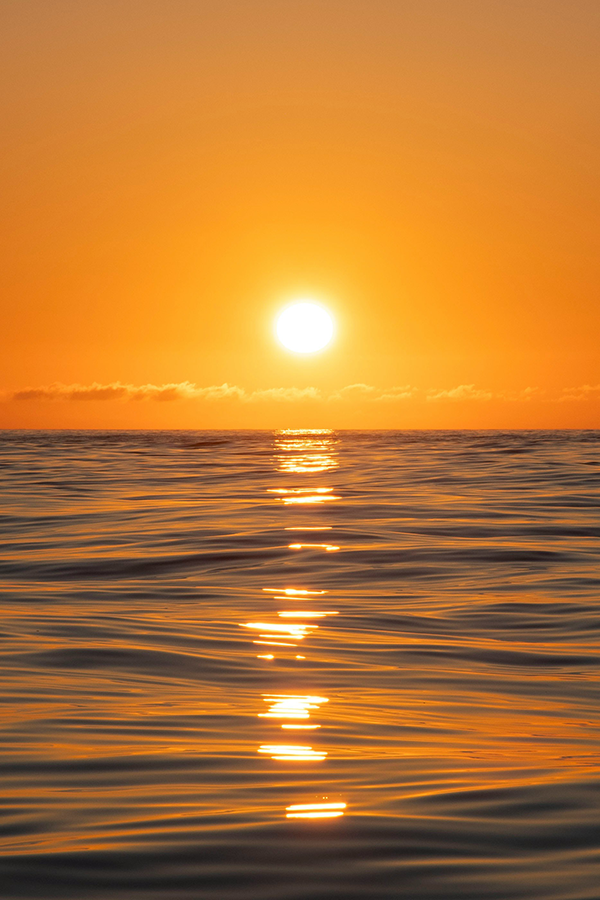
I see a dark band of water in the distance, moving. Hard to tell how big. Maybe a mile long. There’s no thunderstorm to reef our sails for, no squall line visible.
The sea’s surface breaks into lace.
A mega-pod is headed toward us, hundreds, maybe a thousand spinner dolphins roil the sea and surround us. They’re jet-propelled, competing for space at the front of the boat where I sit delighted and squealing like a child as they surf our bow wave.
For a moment, everything else drops away.
I forget about all the congressional letters I wrote back in Puget Sound, the news interviews I gave in Seattle, the congressional briefings I attended, trying to stop the killing. But this! It’s pure joy; there’s no sadness. No room for the memory of military ships with special classified bulges in their bows that make 235 decibels of sonar, enough to blow apart a dolphin, explode the brain and lungs of a whale, rattle the innards of any underwater creature within 300 miles.
Here, in the moment with these dolphins, there is only sun, motion, and the invisible poetry of breath. We belong to each other.
An hour earlier, we passed sperm whales, the loudest animals on Earth, capable of producing the same staggering intensity of sound at 235 decibels. Organic zappers, Rambos of the cetacean world, sperm whales can stun and kill a 15-foot giant squid a mile down. But resting at the surface, they’re gentle giants with brown wrinkly backs shimmering like smooth stones. One lifted its head and looked at me, a holy moment.
We held eye contact in a silence as big as the drift of stars.
I wanted to jump in the water and go with them.

The briefing with the Congressman went as well as could be expected. The funereal list of a million future murders known as “take” under the Marine Mammal Protection Act and the Endangered Species Act was non-negotiable. The secrets of new war machines to be thrust upon an unsuspecting world were inscrutable. The list of things we were allowed to ask for was pitiful: stop ignoring us, please. Be more accountable.
At least admit who you’re harming.
Not what, who. These are oceanic families. Who are we to say there’s no love, no pain, no mourning?

The dolphins are tail-slapping all around the boat. They’re jumping, dancing, and I swear they’re laughing. They crowd the bow so close I am breathless. I extend my legs, wiggling my toes, hoping one might brush my foot. The subtle blue-pink striping near their tails is barely visible until the sun hits it just right, and then it’s spectacular.
I gasp and pour all my love into these marvelous beings. They seem to react to it, crowding closer, which makes me love them more.
We are a spinning, shining little circle of joy, glowing like a meteor.
The Navy plans to increase their war games in the North Pacific Ocean by as much as a thousand percent. They will bombard the cold northern seas, while mostly leaving alone the warmer ones we perceive as more fertile. In fact, the opposite is true—colder waters are often the most fertile. But the remoteness of cold northern seas is a barrier that precludes witness to their abuse. Last time they carried out war games there, thirty large whales died. And those were just the bodies that were found.
There is so much fear, and so many fear-mongers.
Where are the wonder-mongers?
I focus on one dolphin near my left foot, its blue-pink shimmer just beneath, its strong body effortlessly piling on speed.
I love you, I beam to it. You, especially. You are so beautiful.
And suddenly there’s some sort of crazy mind-meld going on, a wild exchange, a brief telepathic visit—I don’t know how else to explain it. I briefly move inside the mind and body of that dolphin. I feel its tail muscles flex, and I feel how sensitive its skin is—dolphins sense with their whole bodies. And I could feel the dolphin’s presence inside my own mind, curious. All this lasts for only a second.
And then it is gone. But not entirely.
When I go home, I am going to make a lot more noise, 235 decibels worth, maybe even 500. No machines, just words. Loud.
I am unable to express my appreciation, awe, and love. I don’t have the language for being, even briefly, inside a non-human creature. I can’t even replicate precisely how it felt. What remains is a memory, and traces of astonishment.
Hints like fossils, telling of possibilities.
With my scientific background, I have always valued logic. I’ve never done this before, never told anyone about this experience, because some people in our rapidly delaminating culture would ridicule and insist that war supersedes any form of awakening.
But here, together in this moment of shared existence, we are all molecules of billion-year-old stardust, alive and vibrating within the shapes and circumstances into which we are born. We are all evolving, spinning into our futures, and while we’re here, now is the time to connect with each other, if we allow ourselves to believe it’s possible.
Karen Sullivan is a former ship captain, marine biologist, science teacher, and federal agency spokesperson who likes sailing small boats to distant places. She has written briefing materials for three cabinet secretaries and two U.S. presidents.
Photo by Emilio Borraz Ortega on Unsplash